From Incident to Improvement: Rapid Response at Beaconsfield Services
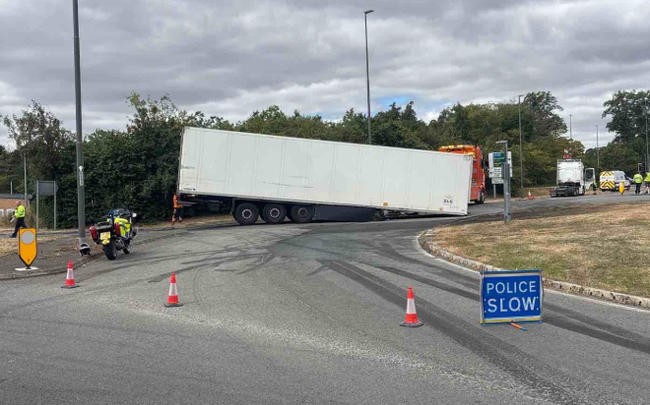
When a diesel spill occurred at Beaconsfield Services, a rapid response and effective partnership working was essential to keep traffic moving and maintain the safety of everyone using the nearby network.
When an incident occurs on Buckinghamshire's road network, a rapid response and effective partnership working is essential to keeping traffic moving and maintaining safety for everyone who uses our roads. That's exactly what happened recently on the A355 Windsor Road roundabout at Beaconsfield Services, where we worked together with partners to quickly respond to a diesel spill and carry out the necessary repairs with minimal disruption.
The incident
On 27 July 2026, a lorry lost its trailer while travelling around the roundabout at Beaconsfield Services, resulting in a diesel spill across part of the carriageway. The affected area was immediately made safe, with a “dress-and-dry treatment” applied to absorb the fuel and traffic management put in place to protect road users and the travelling public.
A "dress and dry" treatment includes spreading a material made of tiny absorbent grains (normally green or white in appearance) over the area of the highway where fuel or oil has been spilled. The material soaks up the spillage and stops it spreading any further e.g. into nearby drains. It is then swept up and removed from the highway leaving the area safe again for road users.
Following an assessment of the damage, a resurfacing scheme was quickly identified and agreed covering 346m² of carriageway (roughly three quarters the size of a netball court*) Information gathered at the scene, including photographs and vehicle details, helped support the response process.
*A standard regulation netball court (as defined by England Netball) is 30.5 m long and 15.25 m wide, giving a total playing area of exactly 465.13 m².
Planning the repair
While the resurfacing area was relatively modest in size, carrying out the work at a busy motorway services roundabout required careful planning and coordination.
Alongside Beaconsfield Services, we identified the most appropriate working window, ensuring repairs could be completed safely while minimising inconvenience to road users. Advance warning signs were arranged and traffic management plans reviewed and adapted to suit the site's operational requirements. A key part of the planning process also involved close liaison with National Highways for a closure of the dedicated slip road on the M40, in preparation for varying traffic levels and ensuring contingency arrangements were in place before works began.
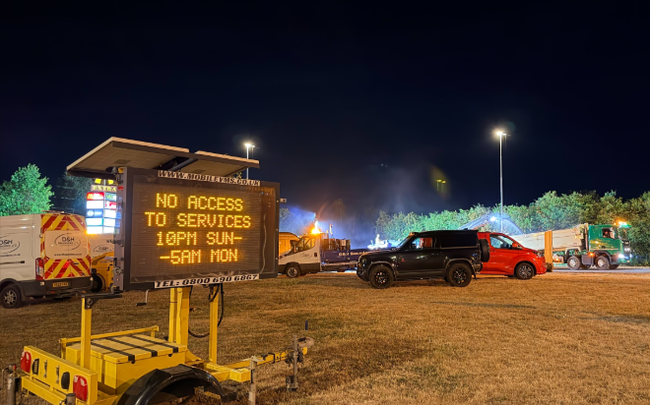
Traffic Management in situ at Beaconsfield Services
Delivering the works
The resurfacing was successfully completed during a controlled night-time operation on 8 August - just 12 days after the original spill. Working overnight allowed the team to undertake the repairs when traffic volumes were lower, reducing the impact on those travelling through the area. Visible traffic management along with advance warning signs and on site marshalling ensured the safe delivery of the scheme.
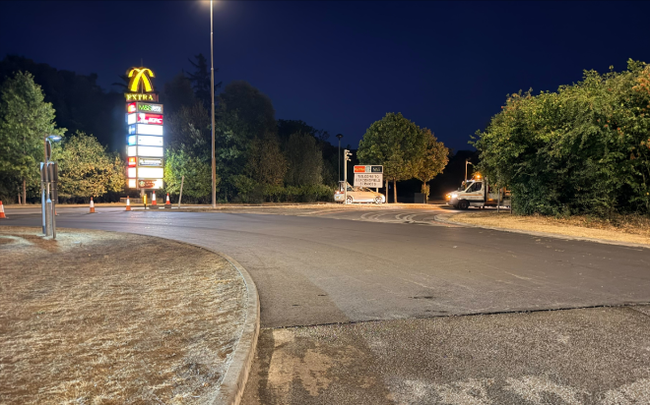
The area of road to be treated at Beaconsfield Services

Road resurfacing works in progress

Road resurfacing works - close up
Working together to keep Buckinghamshire moving
This scheme demonstrates how effective partnership working, forward planning and a quick response can help manage unexpected incidents on the highway network.
From making the site safe immediately after the spill, through to coordinating stakeholders, revising traffic management arrangements and delivering the resurfacing works, every stage of the project was focused on maintaining safety and minimising disruption for road users.
While unplanned incidents can never be predicted, having robust processes and strong relationships in place enables us and our partners to respond quickly and keep the county moving.