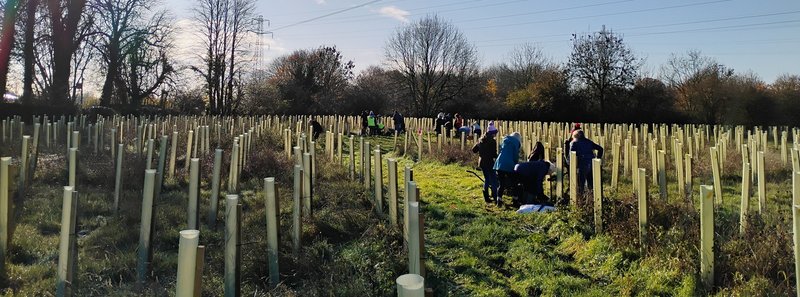
Buckinghamshire Council is on a mission to create a greener, cleaner future for everyone in Buckinghamshire.
What is Bucks Tree Mission?
The Bucks Tree Mission is a programme established in 2021 to meet the council's target of planting 543,000 trees: a tree for every resident of Buckinghamshire. This target is a key part of achieving the council’s Climate Change and Air Quality Strategy.
Trees brings enormous benefits to improve our environment and help mitigate climate change, including sequestering carbon dioxide, reducing the temperature in the areas around them and reducing surface water run-off. New woodland will also provide new and protect existing habitats for enhancing biodiversity, with new wildlife corridors through the landscape and buffering put in place to protect existing semi-ancient woodland. New woodlands also provide a valuable recreational green space for health and well-being for our residents to enjoy, with opportunities to get involved with community tree planting initiatives.
Having spent the first 5 years of the programme planting over 245,000 trees in new woodlands and on our own land, in October 2025 a decision was taken by Cabinet to expand the programme scope to include tree planting facilitated by the council on any land within Buckinghamshire, not just council-owned land. Moving forward, we are encouraging residents and community groups to support tree planting as part of the Bucks Tree Mission: a shared mission to plant trees for a greener future.
Support we can offer for planting Winter 2026-27
Tree Pack Pilot
This winter, we are offering free tree packs to landowners as part of our continued commitment to improve our environment, help mitigate and adapt to climate change, boost biodiversity and improve our green spaces for communities. This is a pilot programme to support landowners across the county as part of the Bucks Tree Mission target to plant 543,000 trees across Buckinghamshire.
For more information on the scheme, check out our Tree Planting Schemes page.
For any questions, before or after submitting an application, read our FAQs or email us at [email protected]
Apply for the Tree Pack Pilot here
Enhanced grant funding offer with Woodland Trust
Bucks Tree Mission is offering to uplift funding agreements issued through Woodland Trust MOREwoods to encourage more tree planting in our county.
If you're a landowner with land available over 0.5ha, you can find more information on the scheme and our uplift offer on our Tree Planting Schemes page.
Read the full details of Woodland Trust funding and eligibility.
To take advantage of this offer, prospective applicants should apply using the Woodland Trust online application process.
Please follow our step-by-step instructions when completing the form to ensure the uplift is applied to your application.
Buckinghamshire Council should be listed as the ‘applicant’ (see instructions for details to include) and landowner details are listed as ‘landowner’.
Interested landowners can also contact the Bucks Tree Mission directly to discuss proposals and application process further [email protected]
Our planting so far
When establishing a new woodland, we always work through a consultation process to assess the:
- local environment
- soil structure
- utilities
- access
- surrounding ecology
We may need approval from Forestry Commission, Natural England and Historic England in some instances.
This information then informs a woodland creation design plan, with silvicultural experts advising on a scheme with appropriately selected species choices and areas of open space to provide a range of habitats.
If the woodland is planned to be open to the public, we may also plan for infrastructure (for example footpaths, access gates, seating and signage).
To ensure the woodland is established successfully, we ensure the woodland has appropriate protection. This could include tree shelters or deer fencing.
We work with the Property team to identify potential sites for creating new woodland, and carry out a series of checks on the environment, soil structure and surrounding area to assess suitability.
We consult with the Forestry Commission and use up to date authoritative forest research data to assess what species would be most successful using climate forecasting and modelling to ensure we are planting the right tree in the right place.
Choosing the species
We only plant native British species and endeavour to reflect what might be locally successful or important.
The following species have been planted in our woodland schemes:
- black poplar
- blackthorn
- crab apple
- eared/grey willow
- field maple
- hawthorn
- hazel
- heritage fruit trees
- hornbeam
- oak
- rowan
- silver birch
- small-leaved lime
- spindle
- wayfaring tree
- whitebeam
- wild cherry
- wild service tree
- yew
Protecting and maintaining trees
Operationally, all our woodlands are established and managed by silviculture professionals, employing teams of contactors to plant and carry out larger works such as spot spraying and mowing open areas.
To protect the trees as they develop, some sites – particularly larger ones – are best served by deer fencing; however for other, smaller sites we use tree shelters. These are made of recycled plastic, are more cost-effective, and are widely recognised to be more durable than most of the biodegradable alternatives currently available.
Many of the biodegradable products on the market have a life expectancy of only 3 to 5 years, whereas we need tree shelters that are study enough to survive at least 5 years, with anticipated removal by year 7.
We will also use a ‘take back’ scheme for the plastic shelters once their purpose has been served. Protecting our young trees from browsing herbivores is very important. Wild deer, especially native species, are a significant and valued part of our natural heritage. Due to several factors (including changes in land use and lack of natural predators) deer density has dramatically increased and poses a significant risk to our woodlands, other animals that rely on this environment, and deer themselves.
Therefore it is very important that we do all we can to protect our new woodlands and keep any pedestrian access gates closed at all times.
If you are aware of any issues on site, for example deer have accessed a fenced site, a tree has fallen on a fenceline or a gate is not functioning correctly, email [email protected]
Our new woodland
We have created 8 new woodlands across the county, largely funded through Forestry Commission’s English Woodland Creation Offer.
These woods are then managed by professional contractors to ensure they meet standards required under the woodland carbon code – the quality assurance standard for woodland creation projects in the UK, and a guarantee that they will generate independently verified carbon units for use to offset the council’s emissions.
After the woodland has been created
These woods are then managed by professional contractors to ensure they meet standards required under the woodland carbon code – the quality assurance standard for woodland creation projects in the UK, and a guarantee that they will generate independently verified carbon units for use to offset the council’s emissions.
Billet Field Wood, Iver
Billet Field Wood, on the edge of Black Park Country Park, was the first wood we created in Feb/March 2022. 3,450 trees and shrubs were planted in a space the size of 3 football fields. Species include pedunculate oak, wild cherry, hawthorn and silver birch, and volunteers helped to plant the last 375 trees.
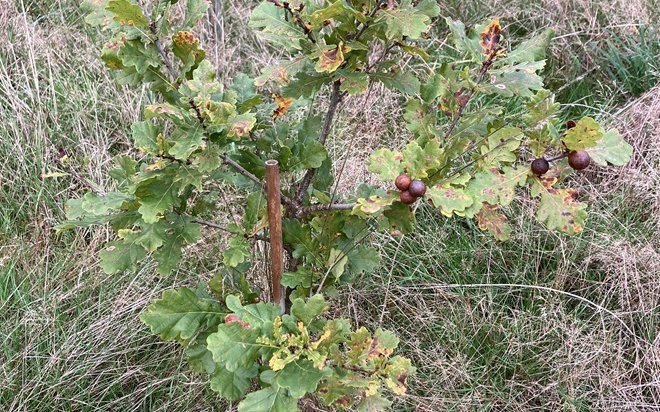
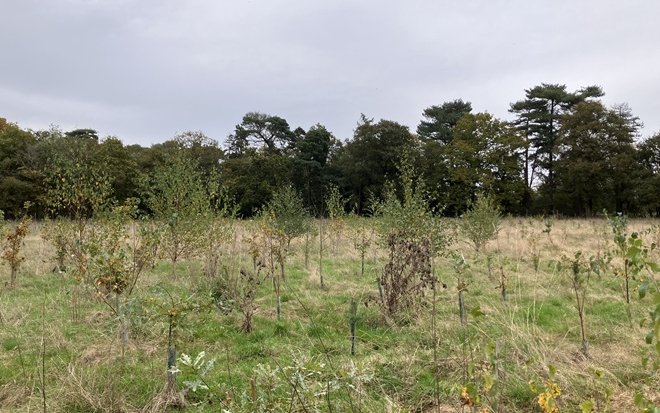
Now 4 years in, the trees are starting to look more like a woodland, and in Summer 2025 this site was officially validated under the Woodland Carbon Code.
Bury Farm Wood, Amersham
In Winter 2023 to 2024 we created woodland at Bury Farm, just south of Amersham. This 7 hectare site now supports 14,300 trees and shrubs, with species selected that are appropriate to the chalky soils and typical of the adjacent trees at Rogers Wood. This includes oak, rowan, hornbeam, crab apple, beech along with shrubbier species including hazel, dogwood and spindle.
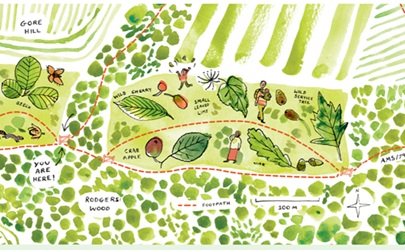
Award-winning local illustrator, Elly Bazigos, was commissioned to create an illustrated map for this woodland, indicating local footpaths and access points.
Grange Farm Wood, Hazlemere
Another site planted in Winter 2023 to 24, this 7.2 hectare site at Grange Farm, near Hazlemere, supports 14,700 trees and shrubs including beech, oak, wild cherry, small-leaved lime and wild service tree.
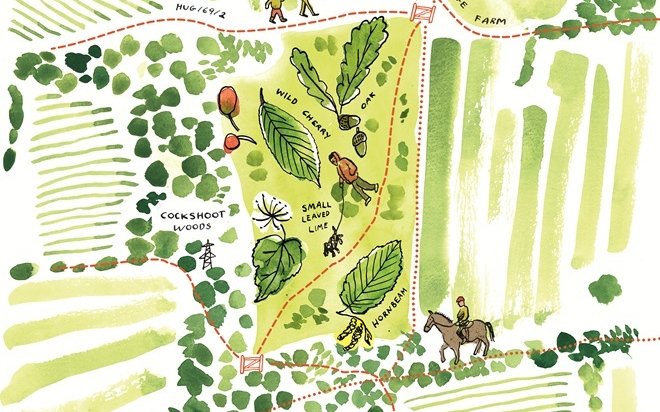
These choices will increase the chance of the trees surviving and create climate resilience for the existing ancient woodlands around the sites. Grange Farm Wood is due to be opened to the public by summer 2026.
Planting in 2024 to 2025
In Winter 2024 to 2025 we established another 5 woodlands that, collectively, are forecast to sequester 2,498 tonnes of carbon over 100 years. To put this in context, this is roughly equivalent of the annual emissions of 543 cars or the annual energy use of 384 homes.
Lower Munt's Wood, Saunderton
At 6.5 hectares, the creation of Lower Munt’s Wood is one of our larger tree planting sites. The wood has been designed to incorporate grassland glades to support diverse habitats and biodiversity, and - once established - new woodland paths for the enjoyment of local walkers. We also installed badger gates into our fencing system to ensure that any night time incursions into the open area can continue. Key tree species include hornbeam, oak, beech, birch, wild cherry, small-leaved lime and yew reflecting the mix of species present in the adjoining semi-ancient woodland at Munt’s Wood (and why it has been named 'Lower Munt's Wood').

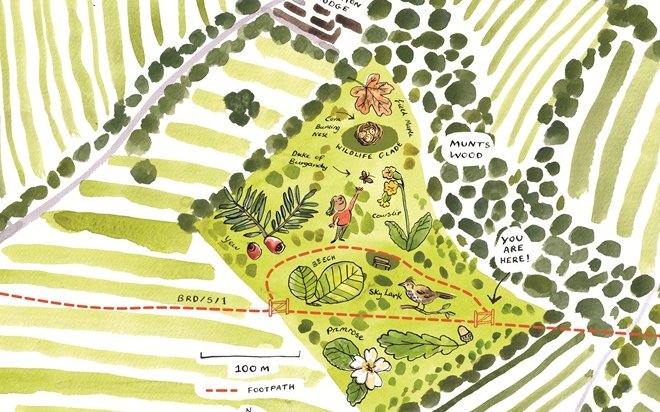
The final 600 trees were planted by a team of brilliant volunteers, including a group of scouts from Aylesbury, at two events hosted by Chiltern Rangers, on Friday 21 and Saturday 22 March 2025.
Roddimore Wood, Winslow
Over 5,000 trees were planted in Roddimore Wood, located between Winslow and Great Horwood in Spring 2025. Planted in recycled plastic tubes, of note is black poplar - an important species for the local area, and blackthorn - a favoured food source for brown hairstreak butterfly larvae – rated as high priority in the area on butterfly conservation lists.
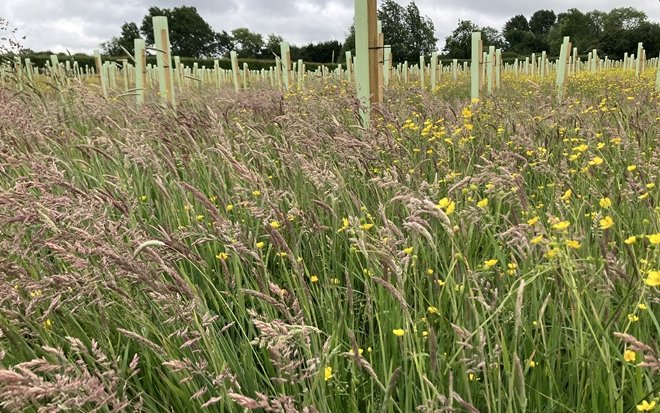
There are two small watercourses running along the edge of this site, so we have incorporated a ‘riparian area’ with species that thrive in wetter conditions, including alder and willows. We do carry out some herbicide sprays in the first few years to give the trees the best chance against local weed competition, but we are endeavouring to keep this to a minimum to retain the existing wildflower and grass biodiversity onsite.
Isle of Wight Wood, Gerrards Cross
The Isle of Wight Wood is a small but mighty 1.1 hectare site that was planted with 2,020 trees in tubes: an intimate mix of broadleaf species including silver birch, wild cherry, hornbeam, small-leaved lime and oak alongside species including field maple, hazel and hawthorn.

The woodland is situated alongside one of the busiest sections of the M25, so in time will directly contribute to improving air quality and noise reduction. Within the site is a dedicated area left open for natural colonisation – a more energy and resource efficient approach to woodland creation that we are trying for the first time. On advice from our planting design experts, this area contains two dense pockets of tree whips in order to boost the success rate for regeneration over the coming years.
Innisfree Wood, Great Missenden
Covering just over one hectare, the tree species that were selected for this small wood are those found in the adjacent semi-ancient woodland, extending wildlife corridors alongside the busy A413.

We have also upweighted species that might provide a future sustainable timber source for coppicing, notably hazel but also some spindle and wayfaring trees.
Huntsmoor Park Wood, Iver
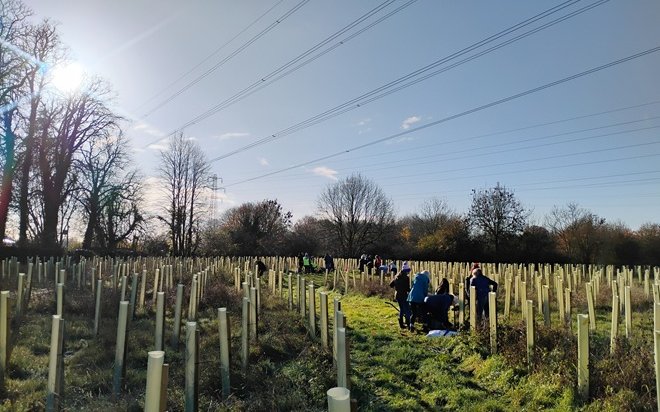
Huntsmoor Park Wood has been designed as a community woodland for everyone to enjoy, with an open area where seating will be installed when the wood is opened up for public use. A high proportion of English Oak trees were planted: oaks support more life forms than any other native tree (over 2,300), hosting hundreds of insect species and supplying many birds with shelter and an important food source. Into the autumn, mammals such as squirrels, badgers, and deer feed on the acorns.
As a nod to the rich heritage of fruit tree growing in 19th and early 20th century Buckinghamshire, additional heritage fruit trees in December 2025 through a community event with Groundwork South. The volunteers planted 24 specially selected heritage species including apples (such as pitmaston pineapple, king of the pippins and Feltham beauty along with additional greengage, damson and mirabelle varietals.

Another Buckinghamshire village, Seer Green, earned the nickname ‘Cherry Pie Village’ and became a popular destination in spring for those wanting to see the cherry blossoms. There will also be a high proportion of English Oak trees planted. Oaks support more life forms than any other native tree (over 2,300), hosting hundreds of insect species and supplying many birds with shelter and an important food source. Into the autumn, mammals such as squirrels, badgers, and deer feed on the acorns.
Other tree planting
Trees have also been planted across the county through the Forestry Commission’s Local Authority Treescape Fund Local Authority Treescapes Fund | Buckinghamshire Council
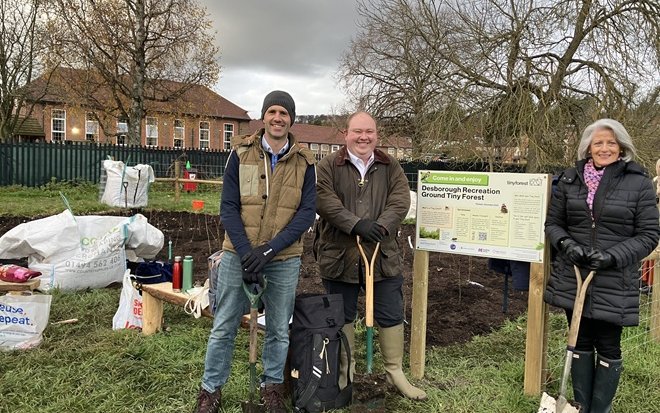
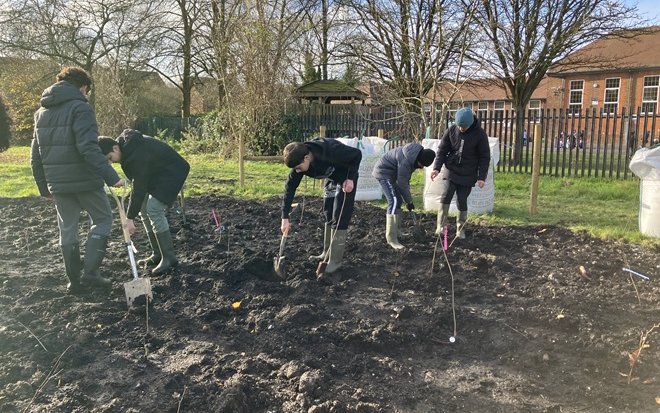
This has included the creation of 7 ‘tiny forests’ in partnership with environmental organisation, Earthwatch at sites at Buckingham, Princes Risborough, Aylesbury and High Wycombe. At each site, 600 native trees and shrubs are densely planted in a small area (about the size of a tennis court) using the Miyawaki method. This approach ensures trees grow fast and close, outcompeting weeds and creating a wonderful habitat for butterflies, birds, bees and other local wildlife.
The most recent tiny forest was planted at Desborough Recreation Ground in December 2025 with volunteers including Millbrook Combined School student council, Uxbridge High School students who were studying the river bank in the park, local residents who regularly walk through the park, community police officers and Councillors Thomas Broom and Jilly Jordan, formerly Cabinet Member and Deputy for Climate Change and Environment.
How to get involved
By working together, we can successfully achieve the targets set out by the Bucks Tree Mission and benefit wildlife and local landscape. By planting the right tree in the right place, we will also help to tackle climate change and support wider ecosystem benefits including carbon sequestration, improved air quality and flood mitigation.
We can offer free help and advice on where to plant, planning checks required, tree species choice, protection, management and grant funding options available on a site-specific basis.
We plant trees with funding and support from both Forestry Commission, Forestry England and Woodland Trust, and depending on the scale and details of your project we may be able to provide some additional support to help deliver as much planting as possible.
You can complete our online form to plant on roads and highways in your community, and our Highways team will review and respond to you.
Find out if a tree has a tree preservation order (TPO).
View the different grants for tree planting projects (PDF, 1.75 MB)
Register your interest
We couldn’t achieve our ambitious tree planting targets without the help of our wonderful volunteers.
If you want to get involved in volunteer tree planting events, you can search on local community boards and forums, we will also update this page with information about public planting events.
You can also get in touch via the Bucks Tree Mission mailbox
Report any issues
If you are aware of any issues at our woodlands that we should know about, please email our Tree Planting Team at [email protected]