Setting Europe Ablaze: The Secret Operations Executive (SOE) in Buckinghamshire
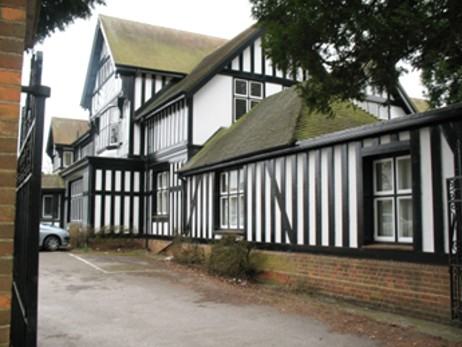
The Secret Operations Executive (SOE) was one of the British Secret Services during WW2. Other secret services included the Secret Intelligence Service SIS (MI6), the Secret Service (MI5), the Government Code & Cipher School (GCCS), and the Political Warfare Executive (PWE).
What was the SOE?
The SOE was set up on 22nd July 1940 by the British government at the direct instigation of Winston Churchill – to ‘set Europe ablaze’. The SOE’s function was to ‘co-ordinate all action, by way of subversion and sabotage, against the enemy overseas’. It mostly operated in occupied Europe, and later in Asia. SOE was in operation for 71 months, cost £2.5 million a year, employed a maximum of 10,000 men, and 3,200 women, and controlled tens of thousands of resistance fighters operating on a global scale.
The SOE was disbanded on 30th June 1946.
How did the SOE operate?
There was a central administration supporting individual ‘Country’ sections including European, Albanian, Middle East and Far East sections. Agents were recruited and trained in a variety of roles, sometimes operating with existing resistance groups, sometimes operating as discrete guerilla or sabotage units with specific targets. Roles of the central support included admin, recruitment, training, supplying equipment, transportation and communications with agents in the field.
Agent recruitment, training and operations
The SOE identified likely candidates, with foreign and dual nationals, linguists and native speakers preferred. In particular, existing service personnel or refugees with a vested personal interest. Female agents were recruited from 1942 onwards as it was easier for women to move around and escape detection after the Germans began forced labour schemes for men in occupied Europe.
Initial interviews were held in central London followed by a lengthy training process, comprising;
- 2-3 weeks (later 1 week) of preliminary training, which was carried out in Surrey. Training included weapons training, map reading, psychological and aptitude tests.
- 3-5 weeks of intense paramilitary-style training in the Scottish Highlands. Paramilitary training involved training in survival, demolition, sabotage, assault courses, unarmed combat & silent killing, further weapons training.
- Parachute training near Manchester. Agents had to complete 4 successful parachute jumps, three from aircraft and one from a tethered balloon, unless they would be using another delivery mechanism by sea or landing aircraft. Norwegian Section agents used the ‘Shetland Bus’, which was the only transport network directly controlled by the SOE, otherwise transport was entirely reliant on the RAF and Royal Navy.
- Finishing schools in Hampshire provided immersive and additional specialist training for the agent’s role. This included training for couriers, saboteurs, wireless operators, also avoiding detection and interrogation. Specialist wireless training took place at Tring Park and (later) at Fawley House and Grendon Hall.
- Holding schools provided final training whilst agents waited for their assignments, then there was a last briefing in London before they were dispatched on missions.
Once an agent had completed their training, they were debriefed in London, with direct feedback of their experiences to the training schools.
Trainees found to be unsuitable or deciding not to continue were sent to a secure ‘cooler’ in the Highlands until it was judged safe for them to return to their previous roles.
What were the SOE facilities in Bucks?
Buckinghamshire was host to a number of SOE activities including;
- Communications – there were radio receptor and transmitter stations at Grendon Underwood & Charndon, Poundon House, Twyford & Signall Hill. Receptor and transmitter stations were paired up and built close together; the SOE’s radio communications were controlled by SIS from Bletchley Park. Charndon was initially SOE’s only transmitter station.
- Specialist wireless training schools – at Fawley Court (from 1942), and Grendon Hall.
- Recruitment and training facilities.
- Holding schools – at Fawley Court (Norwegian Section), Chicheley Hall (Czech Section), Redfield (Italian Section), Roughwood Park (French Section), Pollardswood Grange and Pollards Park (Polish Section). The Norwegian section moved the holding school from Fawley Court to Scotland in December 1941, as it was feared that agents were softening up!
- There is record of a property maintenance depot – but it’s not clear if this was in Bucks or in Hertfordshire.
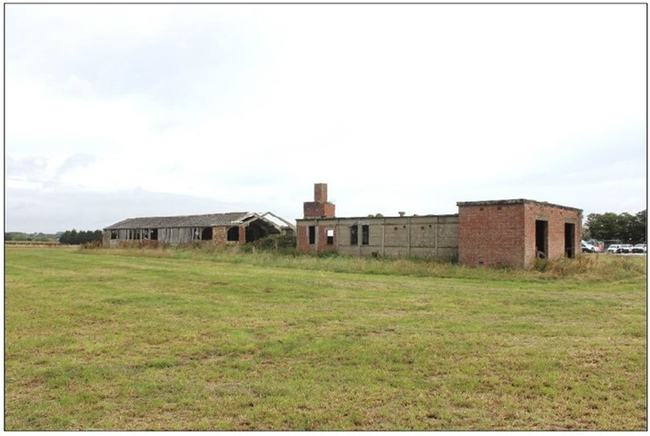
The SOE transmitter station at Portway Farm in Twyford (above) was recorded in 2020, prior to demolition by HS2 (photo © HS2 Ltd).
‘Churchill’s Toyshop’- The Firs, Whitchurch
One of the most unique SOE sites in Buckinghamshire was the secret weapons establishment set up at the personal instigation of Churchill. Known officially as MD1 (Military of Defence 1), and later as MI (R) – Military Intelligence (Research), this establishment gained the nickname ‘Churchill’s Toyshop’. It was responsible for the rapid research, development and testing of weapons for irregular warfare, and later was also involved in the mass production of specific items.
Initially set up in June 1939 in the cellars of Radio Normandie in Portland Place in central London, the workshops were moved to The Firs, Whitchurch in 1940. At its height, more than 250 people were working at The Firs.
26 weapons were developed by MD1/MIR including limpet mines, the sticky bomb, the kangaroo mine, the spigot mortar, the PIAT anti-tank mortar, mine-clearing devices, folding tank bridges, numerous explosive triggers and anti-personnel devices. Weapons were tested and demonstrated to military commanders and other dignitaries in fields to the south of Whitchurch.
MIR was wound up in 1946/7.
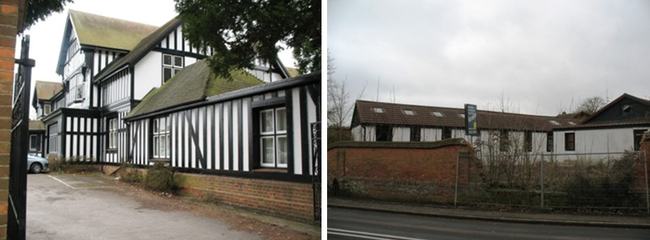
The Firs in 2009. The workshops on the right have since been demolished. (photo © Buckinghamshire Council)
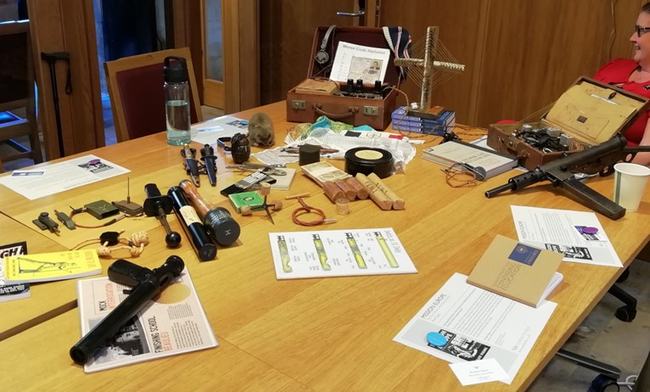
A range of SOE agents’ equipment (above), many developed at The Firs. The photo includes an exploding rat; a clam mine; delay fuses; pull, pressure and release switches; a camouflet set (for sabotaging railway lines), and radio sets. SOE’s radio sets were designed and built at Whaddon Hall. (photo © Buckinghamshire Council)
Details of the SOE sites in Bucks can found on the Buckinghamshire Heritage Portal https://heritageportal.buckinghamshire.gov.uk/ - try a text search for SOE.